Writing · Leading through a pivot · 2 Apr 2026 · 4 min read
What twelve years across eight roles taught me about staying useful
People ask how someone who is easily bored and always looking for the next adventure ended up with a twelve-year tenure. When I left my former consulting firm I said I would never stay that long anywhere again. This is how I learned to never say never, and why it was the opposite of settling down.

I often say that what keeps us in a job is the challenges and the drive to learn new stuff. When people answer “salary, benefits, a non-toxic environment”, I put those in the base of the Maslow pyramid. Of course they matter; if they are not sufficient they are deal-breakers. But they are the basics. What keeps you moving is something else.
Looking back at twelve years in the same company, four things kept changing under me, and between them they made the job a different job every couple of years.
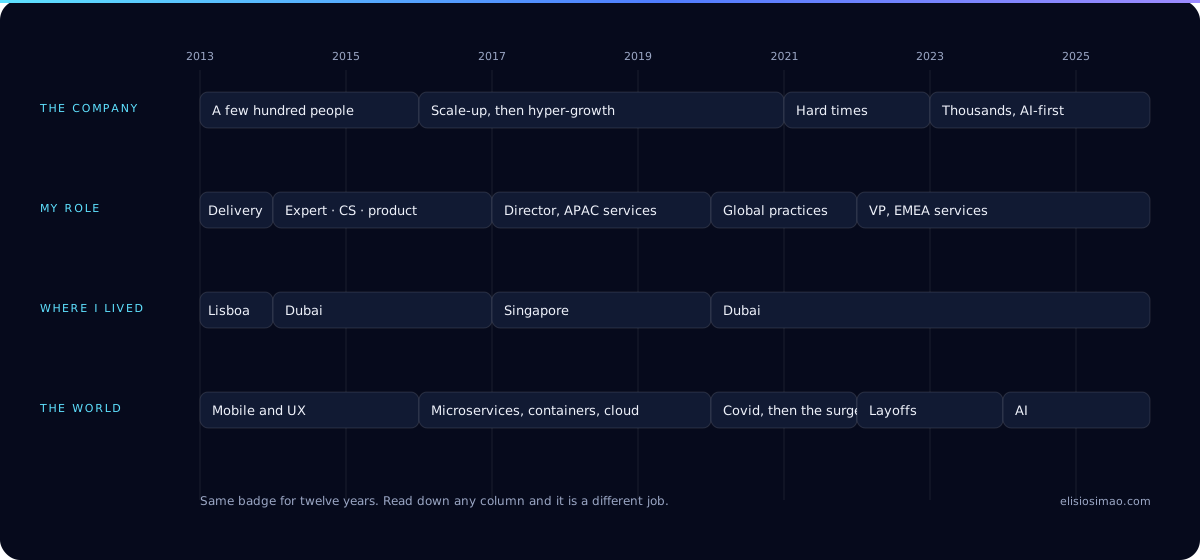
Company growth
When a company is evolving and you are evolving with it, you are working in a different company. I have met several versions of the same one: startup mode, scaling up, hyper-growth, hard times, smooth times. From “I know everyone here and have plenty of friends” to walking onto a stage in Las Vegas where I knew the people at a few tables, and had no clue what the others did or where they were based.
So, effectively, I have worked under different leadership and different boards and investors, each setting a different tone, and through so many transformations that even when my job title did not change, it still felt like a different company.
Your growth
At the same time, I have been doing different stuff. When I worked on a healthcare system, one of my mentors told me: you will learn a lot, and you will get bored once you can do it. He was right about the first part. Demand management and then product management were things I had never done, and I learned a lot. I would not say I got bored; at some point I was ready to try something else. Hopping from delivering projects, to taking customer teams through early-adopter phases, to pre-sales, to creating partner programmes, to writing a new methodology or offering. Working on the first mobile demo we ever did was already a completely different job from the one before it.
The other side is that even when the work was pure consulting, or focused on delivery and adoption, the nature of the job exposes you to different businesses: what their challenges are, what success looks like, how technology helps, and which technology. A core migration is a different beast from a B2C app. One is focused on ETL and the range of data that has to support the business; the other on a killer user experience and the observability to know whether the channel is working.
And the way you grow shapes all of this. There are careers built on specialisation, on being the best of the best at one thing. The other version, the one I adopted, means constantly moving from comfort zones into discomfort zones. Not to invoke the Peter principle, but you keep learning new traits and getting more competent at what you do. I look back at meetings in different cultures, with some amazing examples in Japan, and I cringe at what I got wrong. I remember the advice I got after the first forecast meeting I led: on the numbers, on the detail, on what the strategy was missing, on how I was handling the team. All of which means I grew too. I have been very different versions of myself, with different motivations and vectors of interest, and that made the job different as well.
Location, location, location
In some cases I did the same thing in different places, and oh boy, it was different. Growing the Australian territory is nothing like growing Vietnam or Saudi Arabia. You meet different levels of business and IT maturity, different cultures and context, and your own team and management style have to be different too.
Not to mention that daily life changes when you move: different food, new music, new people, new surroundings. Moving around and adapting is in itself another vector of change in how you operate, and it makes it feel like a totally new environment.
Context
Finally, there is what we are facing. A recession or a boom. Mobile and UX as the trend, then microservices and containers. We had Covid, then a surge in demand with no people available, then the big layoffs, then AI, and markets changing all the way through. The external factors keep changing, and so the job changes with them.
Yes, these are things every role and every career faces, and I am not claiming to be special. But put all four together and it explains how these twelve years went by without me feeling the urge to leave. And of course I was lucky to have amazing people around me, and a technology I believed was the future. That is kind of my Maslow base: I see myself having fun and doing a bit more than taking a pay cheque home.
Never say never
So the answer to the question is that I did not stay in one job for twelve years. I had eight of them, in four countries, in several companies that happened to share a name. The thing I would tell my younger self, the one leaving consulting and swearing he would never do a long stint again, is to measure tenure differently: not by how long the logo on the badge stayed the same, but by how often the job under it changed. When it stops changing, that is the signal. Until then, stay useful and keep moving inside.